









Get to know 22 goth styles and related fashion aesthetics, from traditional goth and deathrock to romantic goth, cybergoth and Gothic Lolita. See the clothing, music references and outfit ideas behind each, with the history that separates goth subculture from styles that borrow its imagery.
Goth began as a music rooted subculture in the late 1970s and early 1980s, growing from post punk around bands such as Bauhaus, Siouxsie and the Banshees, and The Cure. The music came first. Goth fashion developed alongside it as a way to express the scene's atmosphere, community, dark humor, and creative defiance.
Today, searches for “goth style” and “types of goth” bring together several different things. Some goth styles are closely connected to the music and its history. Others come from adjacent scenes, historical dress, Japanese street fashion, club culture, or internet aesthetics that borrow gothic imagery. Those differences matter. This guide explains them without pretending every dark outfit belongs to the same culture.
A note on the categories in this guide We include music rooted goth traditions, goth inspired fashion aesthetics, and adjacent crossovers because people search for all of them as “goth styles.” The differences are explained in the writing so you can explore the fashion without flattening its history.
Find Your Direction
Not everyone who lands here needs the same thing. Start with the history, or use one of these paths to build a look that fits your life.


Learn the Goth Styles
Keep reading for the musical roots, visual influences, and defining features of all 22 styles.
Understanding the Goth Subculture

What Is Goth?
Goth developed from the late 1970s post punk scene and became recognizable through music, clubs, independent media, visual art, and community. Artists frequently placed in its lineage include Bauhaus, Siouxsie and the Banshees, The Cure, Joy Division, and later The Sisters of Mercy, although musicians and fans have not always agreed about who accepts the goth label.
The subculture was never only a clothing category. People found one another through records, concerts, clubs, zines, and local scenes. Goth fashion grew alongside that culture through thrifted clothing, dramatic makeup, DIY customization, dark romantic references, punk influence, and experimentation. The result was expressive and personal, not a store bought uniform.
What Goth Fashion, Gothic Style, and Goth Inspired Fashion Mean
“Goth” most precisely refers to the music rooted subculture. “Gothic” can also describe literature, architecture, cinema, historical references, or a broader mood that existed long before goth music. “Goth inspired” fashion uses elements associated with one or both without necessarily belonging to the subculture.
This distinction does not make newer styles meaningless. It gives credit to their actual origins. Pastel goth, health goth, whimsigoth, and fairy goth can be creative fashion aesthetics without being historic branches of the goth music scene. Emo, industrial, metal, punk, Lolita, and rave culture also have their own histories, even when people combine them with goth style. For a wider map of those neighboring scenes, read our guide to alternative fashion.
The Basis of Gothic Style: Common Elements in Goth Fashion
Goth fashion varies widely, but recurring elements include:
- Black and other dark colors, sometimes interrupted by white, red, jewel tones, or neon
- Velvet, lace, leather, mesh, distressed cotton, vinyl, and layered textures
- Band shirts, goth T shirts, oversized tops, long coats, corsetry, flowing skirts, and fitted separates
- Silver jewelry, religious imagery, occult imagery, romantic symbols, handmade accessories, and chokers or neckwear
- Boots, creepers, winklepickers, platforms, and practical footwear for clubs and shows
- Expressive hair and makeup that may be dramatic, minimal, colorful, or absent entirely
These elements are tools, not requirements. Context and personal expression matter more than checking every box.
22 Goth Styles You Should Know About
1. Pastel Goth
Pastel goth became visible through early 2010s internet fashion communities, especially Tumblr, by combining black clothing and macabre motifs with pastel color, kawaii influence, and playful accessories. It is better understood as an alternative fashion aesthetic than a historic goth music style.
How to Build a Pastel Goth Outfit
Pair black with lavender, mint, pink, or white. Use oversized graphic tops, dark skirts or shorts, playful hair accessories, platform shoes, and kawaii influenced graphics with a sinister edge.
2. Traditional Goth

Traditional goth, often called trad goth, draws most directly from the early goth and post punk club scenes. Band shirts, thrifted black clothing, fishnet, leather, angular silhouettes, expressive makeup, and backcombed hair are common, but the music and scene connection are more important than any single garment.
How to Build a Traditional Goth Outfit
Start with music you genuinely care about. Add a vintage or band shirt, black trousers or a long skirt, a worn leather layer, silver jewelry, and practical club footwear.
3. Victorian Goth

Victorian goth combines dark romantic styling with references to nineteenth century mourning dress, formal tailoring, lace, velvet, high collars, and long silhouettes. It is a modern interpretation of historical fashion, not an unchanged Victorian tradition.
How to Build a Victorian Goth Outfit
Use one strong period inspired element, such as a high collar, waistcoat, long coat, lace blouse, or floor length skirt. Mix it with modern basics so the outfit feels intentional rather than theatrical by accident.
4. Deathrock and Punk Goth
Deathrock grew from the late 1970s and early 1980s Los Angeles punk scene, then developed close cultural ties with goth through shared clubs, aesthetics, and audiences. Its style often emphasizes DIY construction, horror imagery, ripped layers, leather, fishnet, patches, studs, and dramatic hair.
How to Build a Deathrock or Punk Goth Outfit
Customize thrifted pieces, add music or scene specific patches, layer distressed textures, and let the result look lived in. DIY participation is more authentic here than buying a complete costume.
5. Emo and Goth Crossover
Emo and goth come from different musical lineages. Modern outfits sometimes combine emo band culture, early 2000s styling, and goth influenced makeup or dark clothing, but “emo goth” should not be presented as a historic goth subculture.
How to Build an Emo and Goth Crossover Outfit
Combine a band or graphic T shirt with dark fitted or relaxed bottoms, layered sleeves, a studded belt, and expressive eyeliner. Credit both influences instead of pretending they are interchangeable.
6. Gothic Lolita

Gothic Lolita is a branch of Japanese Lolita fashion, which emerged as street style in Japan during the 1990s. It is shaped by Victorian and Rococo references, modest silhouettes, structured dresses, petticoats, lace, and carefully coordinated accessories. Its history is connected to Japanese street fashion and Visual Kei more directly than to the original British goth scene.
How to Build a Gothic Lolita Outfit
Research the conventions of Lolita fashion before assembling an outfit. Proportion, garment construction, petticoat shape, blouses, legwear, and coordinated accessories matter more than simply adding black lace.
7. Mall Goth
Mall goth began as a dismissive label for a late 1990s and early 2000s alternative look shaped by nu metal, industrial rock, pop punk, skate culture, and stores such as Hot Topic. Whatever people thought of the name, the style became a real entry point into alternative music and fashion for many young people.
How to Build a Mall Goth Outfit
Use oversized band or graphic shirts, wide black trousers, striped sleeves, chain details, dark makeup, and chunky footwear. Treat it as a specific turn of the millennium crossover rather than the origin of goth.
8. Military Goth

Military goth is a descriptive fashion term for dark outfits using officer jackets, structured coats, epaulettes, tall boots, straps, and severe tailoring. It is not a major historic branch of goth music, and military symbols should be chosen carefully because their meanings extend beyond fashion.
How to Build a Military Goth Outfit
Focus on structure rather than decoration. A fitted black jacket, long coat, sharp trousers, and sturdy boots can create the direction without using medals or symbols you do not understand.
9. Nu Goth
Nu goth became prominent through Tumblr and social media in the 2010s. It combines minimalist black streetwear, occult and celestial imagery, oversized silhouettes, sheer layers, and contemporary accessories. It borrows from goth, witchy fashion, and internet era alternative style.
How to Build a Nu Goth Outfit
Start with an oversized black graphic T shirt or hoodie, add fitted black bottoms or a long skirt, then finish with silver jewelry and one sheer or structured layer.
10. Boho Goth
Boho goth mixes dark colors and occult or romantic imagery with flowing bohemian silhouettes, natural textures, fringe, long skirts, shawls, and layered jewelry. It overlaps with witchy fashion and festival style more than with a specific goth music tradition.
How to Build a Boho Goth Outfit
Combine a dark fitted base with one flowing layer, such as a skirt, shawl, or pashmina. Add weather appropriate boots and a small number of meaningful accessories rather than covering the outfit in generic symbols.
11. Perky Goth
Perky goth is a playful term for people who enjoy goth culture without performing constant gloom. In fashion, it often means dark clothing mixed with bright color, cartoon references, striped accessories, or deliberately cheerful details.
How to Build a Perky Goth Outfit
Keep a black base, then add one saturated color, playful accessory, or graphic. Personality is the point, not proving that darkness and humor cannot coexist.
12. Romantic Goth

Romantic goth emphasizes dark romanticism, flowing silhouettes, lace, velvet, poetry, gothic literature, and dramatic atmosphere. It has appeared within the goth scene through music, club fashion, and the influence of historical dress.
How to Build a Romantic Goth Outfit
Choose soft movement and rich texture. A velvet top, lace layer, long skirt, poet shirt, or flowing coat works best when balanced with practical shoes and restrained accessories.
13. Soft Goth
Soft goth is a modern label for understated dark fashion that uses comfortable fabrics, simple silhouettes, muted color, and less dramatic styling. It can be useful for people who want a subtle everyday look, but it is not a distinct historic goth subculture.
How to Build a Soft Goth Outfit
Use a dark oversized T shirt, knit layer, relaxed black bottoms, simple jewelry, and comfortable boots or sneakers. Let shape and texture do the work.
14. Steampunk Goth

Steampunk and goth overlap through Victorian references, dark fantasy, corsetry, dramatic tailoring, and speculative design. Steampunk has its own literary, maker, and costuming culture, so the terms should not be treated as synonyms.
How to Build a Steampunk Goth Outfit
Begin with tailoring or a period inspired silhouette. Add crafted mechanical details only when they support a clear concept, rather than attaching random gears to an otherwise unrelated outfit.
15. Cybergoth

Cybergoth grew from a late 1990s and 2000s crossover of industrial club culture, rave fashion, and cyberpunk imagery. Black clothing, neon or ultraviolet color, synthetic materials, platform boots, goggles, cyberlox, and dramatic club makeup became recognizable parts of the look.
How to Build a Cybergoth Outfit
Use a black movement friendly base, one neon color, mesh or reflective texture, and footwear you can safely dance in. Respirators and gas masks are scene imagery, not practical dance floor equipment.
16. Vampire Goth
Vampire goth draws from gothic literature, horror cinema, historical dress, dark romantic fashion, and nightclub theatrics. Velvet, high collars, long coats, lace, deep red accents, and dramatic jewelry create the direction without requiring a literal costume.
How to Build a Vampire Goth Outfit
Choose one decadent focal point, such as a velvet coat, high collar, flowing blouse, or dark red layer. Keep the rest restrained so the silhouette remains strong.
17. Glam Goth
Glam goth combines dark styling with the theatricality of glam rock, nightclub fashion, and high shine materials. Sequins, metallic accents, sharp tailoring, velvet, exaggerated makeup, and platform footwear can all appear in the look.
How to Build a Glam Goth Outfit
Pair a black foundation with one reflective or richly textured statement piece. The contrast between darkness and shine should feel deliberate.
18. Health Goth
Health goth began online in 2013 through artist Chris Cantino and Magic Fades musicians Mike Grabarek and Jeremy Scott. Its original visual language combined monochromatic sportswear, technical fabrics, minimal graphics, rendered environments, and futuristic imagery. Despite the name, it was an internet aesthetic and design exercise rather than a branch of goth music or a rule about who should exercise.
How to Build a Health Goth Outfit
Combine fitted or technical black basics with mesh, reflective details, clean sneakers, and a structured outer layer. Avoid assuming that a body type or level of athleticism is part of the aesthetic.
19. Whimsigoth
Whimsigothic was coined by design archivist Evan Collins as a name for a late 1980s and 1990s visual language that mixed whimsical forms with gothic and celestial motifs. Social media later shortened and popularized the name as whimsigoth, especially for witchy, bohemian, and dark romantic fashion. Velvet, bell sleeves, moons and stars, jewel tones, and a mystical atmosphere are common references.
How to Build a Whimsigoth Outfit
Mix black with plum, forest green, or midnight blue. Use a bell sleeve, velvet layer, sheer shawl, or celestial accessory without treating modern spiritual symbols as disposable decoration.
20. Aristocrat Goth
The popular search label “aristocrat goth” blends several related ideas. Aristocrat fashion is a Japanese street fashion category, while Elegant Gothic Aristocrat is a specific term created by Mana for designs from Moi même Moitié. The look uses mature, formal silhouettes, high collars, tailored coats, waistcoats, long skirts, and restrained decoration influenced by European historical dress.
How to Build an Aristocrat Goth Outfit
Prioritize tailoring, length, fabric quality, and proportion. Research the original Japanese fashion context before using Elegant Gothic Aristocrat as a general label or reducing the look to generic Victorian costume pieces.
21. Haute Goth and Avant Garde Goth
Haute goth is a broad description for runway and editorial fashion using darkness, gothic romanticism, severe tailoring, sculptural silhouettes, or dramatic materials. Designers may use gothic references without participating in goth culture, so this is a fashion lens rather than a defined subculture.
How to Build a Haute Goth Outfit
Focus on silhouette. An asymmetric coat, sculptural top, elongated layer, or unusual proportion can communicate more than a pile of themed accessories.
22. Fairy Goth and Faegoth
Fairy goth combines dark fantasy, folklore, distressed natural textures, layered sheer fabrics, forest color, and faerie imagery. It overlaps with fairycore, fantasy costuming, festival fashion, and witchy aesthetics rather than a specific goth music tradition.
How to Build a Fairy Goth Outfit
Combine a practical base with layered sheers, moss green or twilight color, asymmetry, and organic accessories. For festivals, avoid loose pieces that create safety, weather, or visibility problems.
Goth Streetwear Styles You Can Wear Every Day


Taken together, these 22 goth styles make one thing clear: goth has never been a single outfit. Its fashion keeps changing because people bring music, dark romanticism, punk resourcefulness, club culture, and their own lives into the way they dress.
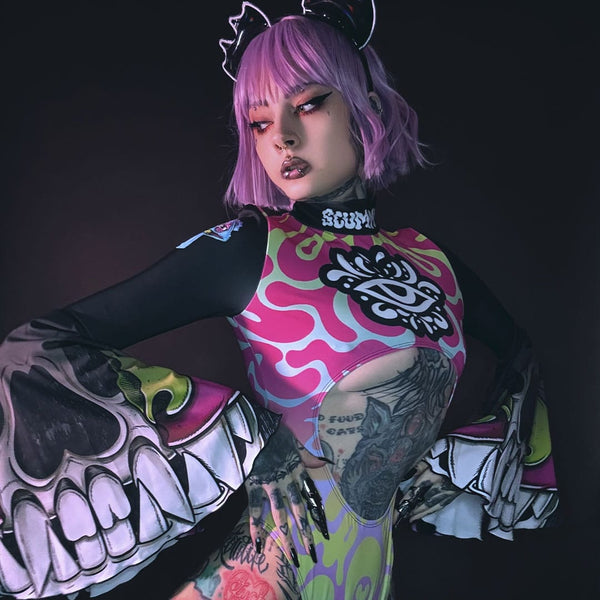
Scummy Bears sits in the overlap between goth influence and neighboring alternative cultures. The references in our work are visible in black foundations, oversized silhouettes, distressed finishes, death and decay imagery, dark romanticism, and occult symbolism. We combine those ideas with metal, tattoo art, bass music, streetwear, and festival culture. The result is goth influenced clothing, not a claim to reproduce every scene described above.
That overlap is most useful in ordinary dressing. Choose one strong foundation, then make it personal with the pieces, music references, and details that already belong to you.
Translating Goth Influence Into Everyday Clothes
One graphic or silhouette can carry the outfit. An oversized goth T shirt works with jeans, cargos, a long skirt, or pieces you already own. Boxier oversized tees give artwork more room without requiring the rest of the outfit to compete with it.
When you want more weight or structure, use a goth hoodie, crewneck, or dark outer layer over a simpler base. The contrast between a loose top and a fitted bottom, or a fitted top and a wider trouser, usually matters more than adding more symbols.
For warmer weather, club nights, or layered festival looks, a bodysuit, fitted separate, or piece from the goth bikinis collection can create the base of the outfit. Treat tops and bottoms as individual styling pieces, confirm what each product includes, and add an outer layer when the setting calls for it.
For a more complete starting point, browse Goth AF, then adapt the look to your own wardrobe instead of copying it piece for piece.
Dark Layers From Scummy Bears


Goth Festival Styles Built for Movement


Festival clothing has a different job from an editorial outfit. It needs to handle heat, cold, walking, dancing, venue rules, bags, hydration, and long hours without losing the visual direction.
Start With the Base Layer
Start with a bodysuit or coordinated top and bottom. Add a cloak, pashmina, or oversized shirt for changing temperatures and coverage between sets.
Let One Element Lead
Choose one focal point, such as the silhouette, artwork, makeup, or a dramatic outer layer. Keeping the other pieces quieter makes the outfit easier to read and usually more comfortable to wear for hours.
Test the Outfit Before the Event
Walk, sit, dance, and reach for your phone while wearing the complete outfit. Check closures, underlayers, pockets, footwear, and any straps or hardware before relying on them in a crowd.
Before You Leave
Check the weather, venue rules, bag policy, expected walking distance, and whether every layer can be carried comfortably. Long straps, unsecured hardware, oversized wings, and obstructive accessories can become unsafe in crowds. Product pages should be used for current fit, fabric, care, availability, preorder, and final sale information.
Dark Festival Pieces From Scummy Bears


.jpg)

.jpg)

.jpg)

Buyer's Guide: Building Your Gothic Fashion Wardrobe Without Buying a Costume


A useful wardrobe begins with pieces you will repeat, not a checklist that tries to prove your identity.
1. Start with music, community, and references you genuinely care about.
2. Build a dark base from clothing you already wear.
3. Add texture through mesh, distressed cotton, velvet, lace, leather, or technical fabric.
4. Choose one strong silhouette or graphic instead of competing focal points.
5. Buy for your actual life, whether that means clubs, festivals, everyday streetwear, or formal events.
6. Use secondhand clothing, DIY customization, independent artists, and new pieces together.
That mixed wardrobe is also the right context for Scummy Bears. The pieces are goth influenced, not a substitute for the music, community, or history, and they work best alongside secondhand clothing, DIY work, band merchandise, independent labels, and whatever is already in your closet.
FAQs: Everything You Need to Know About Goth Style and Gothic Fashion
What Is the Difference Between Goth and Emo?
Goth and emo developed from different music scenes. Goth grew from post punk and gothic rock, while emo developed from punk and hardcore lineages. Their fans may share dark clothing or emotional themes, but the cultures are not interchangeable.
Where Did Goth Originate?
The goth subculture emerged from the late 1970s and early 1980s post punk scene, especially in the United Kingdom, then developed through clubs, bands, independent media, and local communities around the world.
What Makes Fashion Goth?
Within the subculture, fashion is connected to music, scene participation, history, and personal expression. Dark clothing alone is better described as gothic, dark alternative, or goth inspired when that cultural connection is absent.
Do You Have to Wear Black to Be Goth?
No. Black is common because of its visual associations and versatility, but goth fashion has always included white, red, purple, jewel tones, metallics, and other color. Clothing is not a membership test.
Is Goth Connected to a Religion?
No single religion defines goth. Goths may be religious, spiritual, agnostic, or atheist. Religious and occult symbols appear in some fashion and art, but their meanings vary and should not be assumed.
Can Anyone Be Goth?
Yes. Goth is not restricted by race, gender, sexuality, age, body type, disability, or skin tone. Respect for the music, people, and history matters more than fitting one visual stereotype.
What Is the Difference Between Goth and Gothic?
Goth usually refers to the music rooted subculture. Gothic can also describe literature, architecture, cinema, historic revival styles, and a wider visual atmosphere. The terms overlap, but they are not always identical.
Goth Influenced Fashion Beyond a Single Label
You do not need to fit one label perfectly. Use this guide to understand where the styles came from, then build an outfit around the music, silhouettes, textures, and environments that actually matter to you. A thoughtful wardrobe can hold historical references, contemporary clothing, and pieces from several neighboring scenes without pretending they all share the same origin.
Within Scummy Bears, goth streetwear focuses on dark graphics and oversized everyday layers. For fitted separates and layers to wear to electronic, rock or metal festivals, browse Womens Festival Outfits. Goth AF brings those influences together in one concentrated collection, while the wider Scummy Bears catalog moves across goth, metal, tattoo, bass, and alternative fashion.