








Alternative fashion has never behaved itself long enough to become one look. It can be leather and lace, ripped denim and oversized hoodies, battle jackets and platform boots, band shirts, rave pants, black lipstick, neon hair, or something rebuilt by hand because the thing you wanted did not exist yet.
The point is not assembling an approved outsider uniform. It is what the clothes say when the version of normal being offered to you does not fit.
These styles grew in clubs, record stores, skate spots, festivals, bedrooms, warehouses, and local venues. People used them to challenge gender rules, confront politics, recognize one another, and build somewhere to belong. Beneath all the different sounds and silhouettes is a familiar urge: break from the life handed to you, find your people, and make a home together.
This is the story of those collisions, and of how clothing made in opposition to the mainstream kept changing the mainstream anyway.
What Is Alternative Fashion?
Alternative fashion is the loose name we give to styles developed outside dominant fashion culture. Loose is the important word. There has never been one universal alternative outfit, and anyone trying to sell you one has missed the point.
Punk, goth, metal, hardcore, glam, grunge, emo, scene, industrial, nu metal, rave culture, metalcore, deathcore, and styles born online each brought their own music, politics, places, and visual codes. They overlap constantly, but they are not interchangeable.
What connects them is the use of clothing as more than decoration. A look can signal music taste, community, resistance, sexuality, gender expression, grief, humor, aggression, fantasy, or simple refusal. Sometimes it announces exactly where you belong. Sometimes it tells the right person that you are still looking.
That search is part of the culture. A show, club night, record store, forum, or group of friends can be the first place someone stops feeling strange for being exactly who they are. The best scenes do not erase difference. They make room for it.
There is no required color palette and no test you have to pass. There is, however, history worth knowing.
Alternative Does Not Mean One Color, Sound, or Culture
Black clothing matters in goth, metal, punk, emo, and industrial style, but it is not an entry requirement for alternative fashion. Neither are guitars.
Alternative style can be bright, athletic, tailored, futuristic, glamorous, handmade, stripped down, or completely overloaded. It can grow around a band, a DJ, a skate spot, a neighborhood, an art movement, or a community that had to create its own space. Calling all of that one dark rock look erases most of the story.
Hip hop belongs in that story. From the beginning, Black and Latino youth in the South Bronx used tracksuits, sneakers, denim, Kangol hats, gold jewelry, African inspired dress, and customized pieces to communicate neighborhood, ambition, pride, resistance, and identity. Run DMC turned Adidas into a cultural symbol. Dapper Dan remixed luxury for Harlem before fashion houses understood the value of the audience watching him. Cross Colours, Karl Kani, FUBU, and Baby Phat proved the culture could build its own fashion institutions.
The exchange never moved in only one direction. Punk and hip hop met in downtown New York. Rap, metal, hardcore, industrial, and electronic music kept crashing into one another. Ballroom and queer club culture transformed fashion, dance, language, and performance. Harajuku, visual kei, and Lolita fashion built distinct Japanese street worlds that influenced people far beyond Japan. Local scenes across Latin America, Asia, Africa, Europe, and the rest of the world adapted imported sounds to their own politics, traditions, climates, and realities.
Alternative fashion does not belong to one race, country, class, gender, sexuality, or type of music. It is an ongoing exchange, which is exactly why credit matters. Influence becomes erasure when the people who built a look disappear from its story.
Rave culture also deserves its own place here. Traditional alt guides often push it aside because its roots are in dance music, clubs, sound systems, and warehouses rather than guitar scenes. We see it as a distinct branch of alternative culture, with its own music, politics, handmade traditions, and clothing designed around movement and collective release.
Before Alternative Fashion Had a Name
Long before stores had an alternative clothing category, young people were already using clothes to separate themselves from the adult world.
In the 1950s, British Teddy boys revived Edwardian tailoring and made it sharp, confrontational, and unmistakably young. Greasers and biker culture turned leather, denim, white shirts, and heavy boots into symbols of danger and independence. Beatniks rejected polished postwar respectability with dark basics, workwear, and a deliberately intellectual uniform.
The 1960s brought mods, rockers, hippies, psychedelia, and a growing belief that young people could create a culture of their own. Mods built precise looks around fitted suits, parkas, scooters, soul, rhythm and blues, and modern design. Hippie clothing became tied to antiwar politics, communal living, craft, and rejection of consumer culture, even as the mainstream quickly learned how to sell a cleaned up version of it.
None of these scenes existed outside class, race, sexuality, economics, or access. White rock culture borrowed constantly from Black music, dance, and style while the people it borrowed from rarely received equal recognition or reward. That tension follows alternative culture through nearly every era that came next.
Glam Rock Made Transformation Part of the Show


By the early 1970s, glam rock made visual transformation inseparable from the music. Marc Bolan shimmered in satin and glitter. David Bowie used makeup, costume, and characters such as Ziggy Stardust to make identity feel changeable. The New York Dolls mixed street grime, womenswear, heels, and exaggerated rock and roll swagger. Alice Cooper dragged horror into the arena.
Designers were part of the noise. Kansai Yamamoto's work with Bowie proved that silhouette, color, makeup, and movement could build a complete world around a performer.
Glam gave later punk, goth, new romantic, hair metal, and queer club culture permission to become more theatrical. Its real charge was not simply that men wore makeup. It was the suggestion that the person you had been told to be might be only one possible version of you.
Punk Turned Clothing Into Confrontation

.jpg)
Punk did not begin with one designer, band, or city. In New York, artists around CBGB and Max's Kansas City stripped rock down until it felt dangerous again. Patti Smith brought poetry, androgyny, and thrifted simplicity. Richard Hell ripped and reconstructed his clothes. The Ramones made leather jackets, jeans, sneakers, and bowl cuts look like a gang uniform anyone could copy.
London gave punk a different political voltage. Economic decline, youth unemployment, and class anger filled the room. Vivienne Westwood and Malcolm McLaren's shop at 430 King's Road, known at different points as SEX and Seditionaries, sold bondage trousers, fetish references, provocative graphics, and pieces that helped define the public image of British punk. The Sex Pistols turned that image into a media crisis. The Clash tied the look to more explicit political commitments, while the Slits pushed against gender expectations inside the scene itself.
The lasting idea was bigger than safety pins and torn shirts. Clothing could be cut, painted, pinned, printed, and rebuilt without waiting for the fashion industry to approve it. A kid with a marker and a ruined jacket had agency.
Punk politics were never unified. Anarchism, antiracism, leftist organizing, nihilism, shock, and personal rebellion existed together and often fought with one another. The scene also exposed a contradiction that never went away: the mainstream can put a price tag on rebellion almost as quickly as rebellion invents a new look.
Post Punk, Goth, New Wave, and Industrial Built Darker Worlds


When punk splintered, the music became stranger, colder, and more atmospheric. The clothes followed.
Siouxsie Sioux's severe hair and graphic eye makeup became instantly recognizable. Bauhaus released “Bela Lugosi's Dead” in 1979, a record now treated as an early gothic rock landmark. The Cure, UK Decay, the Sisters of Mercy, Christian Death, and other bands built different corners of the culture. The Batcave, which opened in London in 1982, gave the emerging scene a physical home.
Goth fashion pulled from punk, glam, horror, fetishwear, religious imagery, historical dress, romanticism, and club experimentation. Black mattered, but goth was never simply people wearing black. Deathrock, traditional goth, romantic goth, and later cybergoth developed different silhouettes because the music and communities behind them were different too.
New romantic and club culture pushed theatrical dress in brighter directions. The Blitz club, Boy George, Steve Strange, Leigh Bowery, and later nights such as Taboo treated the body as a stage. Industrial culture moved the other way, toward uniforms, boots, hardware, leather, distressed layers, and machinery. Throbbing Gristle, Einstürzende Neubauten, Ministry, Skinny Puppy, and Nine Inch Nails gave severity its own visual language.
These scenes did not share one political program. Their challenge was often embodied instead. They made conservative ideas about beauty, gender, sexuality, religion, and respectability look far less permanent simply by walking into the room.
Metal Made the Artwork as Important as the Uniform
Heavy metal built one of music's most complete visual worlds. Black Sabbath gave early metal its darkness. Motörhead brought biker culture and military typography. Iron Maiden turned Eddie the Head and album art into a universe fans could carry on their backs. Thrash made patched denim vests, high top sneakers, leather jackets, and band shirts into a running record of taste and allegiance.
Judas Priest changed metal's silhouette when Rob Halford brought leather, studs, caps, and chains associated with gay leather culture onto major stages. The look became so embedded in metal that many fans adopted it without knowing where it came from. Alternative culture has often absorbed queer style more readily than it has defended queer people, and that history should not be cleaned up.
The 1980s also put metal in direct conflict with conservative politics. The PMRC hearings and parental advisory campaign turned lyrics, album covers, sexuality, and supposed Satanic influence into a national panic. Predictably, trying to make the music forbidden only made the imagery more powerful. A shirt, patch, or record became proof that you were listening to exactly what adults wanted removed.
Hair Metal Turned the Sunset Strip Into a Runway


Glam metal, usually called hair metal, took heavy music's theatrical side and blew it up for the MTV era. Mötley Crüe, Poison, Ratt, Cinderella, Twisted Sister, and their peers built huge images around teased hair, makeup, leather, spandex, scarves, jewelry, and custom stagewear. On the Sunset Strip, the stage and the sidewalk became the same runway.
Guns N' Roses came out of that world with more punk grime and street danger, but they understood image just as completely. Music videos and magazines carried Los Angeles style everywhere.
The politics were messy. Men in makeup, crop tops, animal print, and towering hair disrupted conservative gender presentation. Much of the culture surrounding them still sold a version of masculinity based on conquest, misogyny, and excess. Both things can be true.
Grunge turned hair metal into a punchline almost overnight, but the visual influence never vanished. Modern stagewear, drag, glam revivals, festival styling, and every return of exaggerated rock silhouettes still borrow from the Strip.
Hardcore, Skate Culture, and Clothes Made to Move


Hardcore stripped punk down, sped it up, and built its own routes between cities. Black Flag, Bad Brains, Minor Threat, Agnostic Front, Cro Mags, and regional scenes across the United States survived through all ages shows, independent labels, photocopied flyers, zines, and relentless touring.
The clothing followed the room. Band shirts, hoodies, work pants, shorts, sneakers, and boots had to survive sweat, concrete floors, and bodies in motion. Skate culture overlapped naturally, bringing Vans, Converse, Dickies, independent labels, video culture, and a looser approach to proportion.
The politics varied wildly. Straight edge rejected drugs and alcohol. Other parts of the scene organized around antiracism, animal rights, labor, or local community. Violence, exclusion, and macho gatekeeping existed too. No scene earns a free pass just because it was built underground.
Hardcore's lasting influence is everywhere: bold back prints, limited shirts, oversized hoodies, local loyalty, and the belief that a small group of people can build the infrastructure they need instead of waiting for permission.
Grunge and Riot Grrrl Rejected the Spectacle
By the end of the 1980s, the Pacific Northwest was producing heavy, damaged music that looked nothing like the polished excess dominating MTV. Nirvana, Soundgarden, Alice in Chains, Pearl Jam, Mudhoney, Hole, and L7 were grouped under grunge even when the label flattened real differences between them.
Flannel, thermal shirts, cardigans, worn denim, secondhand dresses, combat boots, and wrecked sneakers made sense in a cold region and in bands without arena budgets. The lack of polish was part of the appeal. Once magazines and designers copied it at luxury prices, anti fashion became fashion all over again.
Riot grrrl gave the era a sharper feminist force. Bikini Kill, Bratmobile, Heavens to Betsy, Sleater Kinney, and a network of self published zines confronted sexual violence, body image, reproductive rights, and the lack of space for women in punk. Clothing could be confrontational, playful, deliberately feminine, thrifted, written on, or torn apart. The point was control over the body wearing it.
The movement also carried blind spots around race and class that women of color challenged from inside and outside the scene. Calling yourself alternative does not automatically make a space inclusive. That work still has to be done.
Rave Culture Created Freedom After Dark

Rave culture is not a bright version of rock based alternative fashion, and it should not be folded into dubstep as if the two are identical. It has its own history, communities, politics, rituals, and visual language.
Disco, Chicago house, Detroit techno, New York garage, and ballroom culture were shaped by Black, Latino, and queer communities creating freedom where the outside world offered very little. Those dance floors were not only an escape. They were places where people could move, dress, desire, and belong differently, then carry some of that freedom back into daylight.
In Britain, acid house and the Second Summer of Love pushed dance music into warehouses, fields, and illegal parties. Bright color, sportswear, handmade accessories, oversized pants, reflective materials, masks, and clothing designed for hours of movement developed across different scenes. In New York, Club Kids treated nightlife as performance art. In London, Leigh Bowery made the club feel like a laboratory for identity.
UFO, Kikwear, JNCO, Cyberdog, and kandi culture became recognizable in different corners of the 1990s and early 2000s. None of it was merely decoration. Clothing helped create the atmosphere, made people visible to one another, and turned temporary spaces into something that felt like home.
Authorities understood the power of those gatherings too. Raves faced raids, drug panic, and laws designed to suppress unlicensed parties. Britain's Criminal Justice and Public Order Act of 1994 famously targeted music characterized by repetitive beats.
The modern festival industry made electronic music far more visible, but the culture did not begin with corporate stages. Sound systems, underground organizers, queer nightlife, Black musical innovation, and people willing to build a room from nothing came first.
Nu Metal Broke the Genre Dress Code


Korn's self titled debut arrived in 1994 and changed both the sound and silhouette of heavy music. Jonathan Davis wore Adidas tracksuits, kilts, black nail polish, and makeup, pulling from metal, hip hop, funk, goth, industrial, and the alienation of kids who never felt at home in conventional metal culture.
Deftones brought skate style, workwear, Chicano influence, and a more atmospheric mood. Limp Bizkit made backward caps and oversized sportswear part of mainstream rock. Slipknot built a complete mythology from masks and industrial uniforms. Linkin Park made turntables, rap, melody, electronics, and heavy guitars feel natural in the same song.
JNCO jeans, Adidas, Dickies, skate shoes, chains, piercings, jerseys, and oversized silhouettes flooded metal crowds. Family Values Tour, Total Request Live, Headbangers Ball, and music videos carried the collision into millions of homes.
Critics mocked nu metal for years. The people who found a language for trauma, vulnerability, genre mixing, and not fitting in were listening to something more useful. The scene had real problems with masculinity, misogyny, and careless borrowing, but its influence is now impossible to deny.
Emo, Pop Punk, and Scene Made Vulnerability Visible

Emo did not begin with skinny jeans or mall stores. The term grew from emotional hardcore in the 1980s and moved through a varied 1990s underground that included Rites of Spring, Embrace, Sunny Day Real Estate, Cap'n Jazz, and Mineral.
By the early 2000s, Jimmy Eat World, Thursday, Taking Back Sunday, The Used, My Chemical Romance, Fall Out Boy, and Paramore brought different combinations of emo, pop punk, post hardcore, and theatrical rock to a much larger audience. My Chemical Romance made survival, grief, and transformation feel as large as any arena spectacle.
The look became familiar: band shirts, skinny jeans, studded belts, Converse, Vans, hoodies, eyeliner, dyed hair, side swept fringes, and military inspired jackets. At its best, it made emotion visible rather than embarrassing.
Scene culture grew beside it and turned every dial up. MySpace profiles, huge hair, neon color, animal print, cartoon graphics, facial piercings, and overloaded accessories created an identity that lived at shows and on screens at the same time. The profile photo mattered almost as much as the outfit because, for many people, the internet was where the scene existed first.
Hot Topic and brands such as Tripp NYC, Lip Service, Atticus, Drop Dead, Iron Fist, Vans, and Converse brought pieces of the culture into suburban malls. That access blurred the line between community and consumer category, but it also gave an isolated kid in a small town a door into a much larger world.
Metalcore, Deathcore, and the MySpace Merch Explosion


Metalcore existed long before its 2000s breakthrough. Converge, Earth Crisis, Hatebreed, and other bands fused hardcore structures and ethics with metal riffs and intensity before Killswitch Engage, Atreyu, Avenged Sevenfold, and later waves pushed different versions of the sound onto bigger stages.
Deathcore brought death metal technique and vocals into a breakdown centered scene. Job for a Cowboy's early online explosion, Suicide Silence, Whitechapel, Despised Icon, Chelsea Grin, and Bring Me the Horizon's first era became major reference points.
MySpace changed how all of it traveled. A song, profile layout, logo, photograph, and shirt design could hit someone at the same time. Merch tables kept touring bands alive and turned fitted shirts, zip hoodies, oversized prints, neon monster graphics, basketball shorts, skinny jeans, gauges, tattoos, and long fringes into a shared visual language.
Warped Tour became the moving intersection. Skate punk, ska, pop punk, post hardcore, emo, metalcore, and adjacent scenes shared one long day. You could arrive for one band, find three more, and leave wearing proof that your world had just grown.
Dubstep Carried Sound System Culture Into a New Era
Dubstep did not begin on an American festival stage. It grew in South London from UK garage, dub, jungle, grime, and sound system tradition. Big Apple Records in Croydon became a meeting point. FWD>> gave the emerging sound a room. Skream, Benga, Hatcha, Kode9, Digital Mystikz, Loefah, Youngsta, and others pulled it in different directions.
DMZ, founded by Mala, Coki, and Loefah, became a defining label and club night. Bass weight, negative space, community, and a sound system strong enough to make the music physical were the point. Mary Anne Hobbs's Dubstep Warz broadcast in 2006 helped carry that feeling to a much wider audience.
As the sound crossed the Atlantic, it mutated. Skrillex and a wave of North American artists pushed a brighter and more aggressive version into clubs and festivals. Heavy drops, mosh pits, metal collaborations, horror visuals, and massive production brought electronic and heavy music crowds into closer contact.
The clothes followed the environment: artist shirts and jerseys, oversized hoodies, pashminas, face coverings, practical bags, hats, and layers built for long nights. The festival did not replace the underground, but it created another place for these cultures to collide.
Alternative Subcultures Are Changing Right Now
The borders between scenes are more porous than they used to be. Streaming lets somebody move from deathcore to dubstep to darkwave without changing devices, record stores, or friend groups. Mixed festival lineups and cross genre collaborations make those jumps visible in the same room.
You can see it in the crowd. Metal fans wear artist jerseys. Ravers wear graphics that once belonged only on death metal shirts. Emo and nu metal silhouettes are back. Goth makeup sits beside streetwear. Hardcore, techno, industrial, anime, tattoo art, Y2K sportswear, and festival utility can exist in one outfit without asking permission.

That does not mean every scene has melted into one culture. Goth still has its own music and history. Metalcore is not dubstep. Punk politics cannot be reduced to ripped denim. Rave culture carries roots that a festival outfit alone cannot communicate.
But pretending nobody can move between scenes ignores how people actually live. The overlap is real.
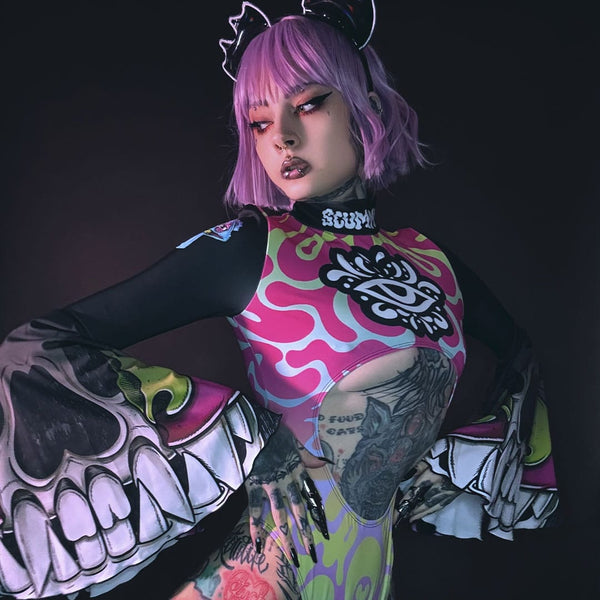
That overlap is what we mean by heavy music culture. It is not an old scene we are claiming or a replacement for any existing one. It is a name for the present tense space where metalcore, deathcore, metal, dubstep, rave culture, emo, goth, industrial, and the people moving among them meet without surrendering their roots. Scummy Bears comes from that collision.
The mainstream complicates things further. Fashion houses, mall retailers, celebrities, and fast fashion have borrowed bondage details, distressed denim, band shirts, platform boots, chains, piercings, dark makeup, colored hair, oversized silhouettes, and rave clothing. Signs that once marked someone as an outsider can now appear in an ad with none of the music, politics, or community attached.
That can feel like theft, especially when people who were harassed for a look watch it become profitable on someone else. It can also create access. A kid far from a major city can find a band, learn the history, recognize themselves in a style, and meet people they may never have found otherwise.
At its best, alternative culture gives people more than references to wear. It offers proof that there are other ways to live, and other people looking for the same freedom. The music and clothing matter. So does the relief of walking into a room and realizing you do not have to translate yourself.
The answer is not to lock the doors behind us. Keep the roots visible. Support artists, venues, photographers, promoters, independent brands, and local communities. Customize things. Show up. Stay curious. Let the culture change without pretending its history never happened.
Alternative culture stays alive by moving, and by giving every generation another way to find one another and make a home of its own.
Research and image notes
This article was checked against museum, archive, and scene history sources including the Smithsonian, the Museum at FIT, the Metropolitan Museum of Art, the Library of Congress, the Rock & Roll Hall of Fame, London Museum, and artist run archives. Historical image credits and licenses appear with each photograph.
Header photograph: Emotreff Düsseldorf, 2022, by Awkward.violence, licensed under Creative Commons Attribution ShareAlike 4.0, via Wikimedia Commons.
